GEO versus SEO · Application

What goes on an SEO team's GEO checklist on Monday?

Most of the backlog does not change. What changes is the acceptance test, the report and one new budget line, and every item carries its evidence grade.

On this page
Share this
Share on X Share on LinkedIn
The short answer

Keep almost the whole backlog: the tasks an SEO team already runs stay, with a new acceptance test rather than a replacement. What changes on Monday is the report, the acceptance test and one new budget line. The largest controlled benchmark in the field found context position one worth 2.77 rank places in retail against 0.36 for the best content rewrite, with only 3 of 54 cases significantly positive.2

Key takeaways
  • Keep indexation, server-rendered text, ranking work and topic-cluster breadth: every answer engine retrieves before it writes, so these are prerequisites, not competing priorities.
  • Start four things: a fixed prompt panel sampled repeatedly, per-engine reporting, reading the answer text on comparison and objection questions, and an off-site budget line.
  • Stop nine habits, among them blended cross-engine scores, single-run spot checks, rewriting pages that already rank first, and forecasting traffic from citations.
Continuity

What does not change on Monday?

The backlog does not change. That is the finding. Every major answer engine retrieves before it writes, and the retrieval layer is a search index: Google states in its own documentation that its generative features are rooted in its core Search ranking and quality systems,8 and that a page must be indexed and eligible to be shown in Google Search with a snippet to be used at all.7 Whatever your team already does to make pages findable is a prerequisite for everything else.

What changes first is the report, not the roadmap. The largest controlled benchmark found context position one worth 2.77 rank places in retail against 0.36 for the best content rewrite, with 3 of 54 cases significantly positive, none in question answering.2 That result is why the GEO versus SEO stage treats GEO as a specialisation layered on search work rather than a replacement channel.

One more thing that does not change: the file you were told to publish. Google's documentation states plainly that you do not need new machine-readable files, AI text files, markup or Markdown to appear in Google Search including its generative capabilities, because Search itself does not use them.8

Keep

What should the team keep doing, and on what evidence?

Keep the six items below. None needs a new owner, a new tool or a new meeting.

Keep doingEvidence gradeWhat it rests on
Indexation, speed, server-rendered textStated prerequisiteFirst-party: a page must be indexed and snippet-eligible7
Ranking work: relevance, links, internal structureStrong, in controlled settingsContext position beat every rewrite tested2
Topic-cluster breadth across the fan-outModerateFirst-party: AI surfaces issue multiple related searches7
Updating existing pages over publishing thin new onesModerate, commercial and time-sensitive queriesSurvey's recency grade; a 252,000-trial factorial found effects for explicit dates and prices11
Earning genuine third-party coverageDirectionalOn commercial questions much of the answer is not your domain
Shipping schema for rich results, claiming nothing moreNo AI-citation claim availableFirst-party: no special structured data is required8

The last row causes arguments, so state it precisely. “Schema markup improves AI citations” is contradicted by the only matched-control test published on the question: a vendor study of 1,885 pages that added JSON-LD between August 2025 and March 2026, matched against 4,000 controls over 30-day windows, found AI Overview citations down 4.6%, a significant result, with no significant change on two other platforms.13 Google's own documentation says the same from the other direction. Keep shipping it for rich results and machine-readability; delete the AI-citation justification from the ticket.

Start

What genuinely new work should start?

Four things are genuinely new, and only one of them is a content task.

Sample repeatedly instead of spot-checking

Build a fixed, versioned prompt panel and run it on a schedule. The 2026 critical survey reports repeat runs of one query overlapping at Jaccard 0.34–0.42, with 9–28% of repeated decisions changing where sampling can be controlled, and concludes that a point estimate is not a stable indicator.1

Report per engine, with an interval and a version

A SIGIR 2026 study of 11,500 queries measured URL-level Jaccard similarity of 0.11–0.18 between three answer surfaces belonging to a single company.9 A blended score averages populations that barely intersect and cannot answer the question it exists for: which engine to work on next.

Read the answer text on comparison and objection questions

A Tow Center audit of 1,600 queries across eight engines found more than 60% returned incorrect answers, with the best engine still wrong 37% of the time.6 On a high-stakes question a citation attached to a wrong description is worse than absence.

Open an off-site budget line

This is the one genuinely new line item: on commercial questions a large share of what gets cited is third-party write-ups and community threads rather than any vendor's own pages. It is slower than on-page work and it is not the content team's job, so it needs its own budget.

One editing habit is worth adding to the content team's definition of done: write each section so it survives being lifted out of the page with no surrounding context. That means answering the heading in the first sentence, baking qualifiers into the sentence rather than the paragraph before it, and putting real dated attributed numbers in the body. The survey grades extractable evidence, meaning figures, definitions and comparisons, moderate to strong, its highest-rated content lever, with one binding condition: the criterion is not to add numbers but to provide relevant, verifiable, dated and properly attributed evidence.1

Stop

What should come out of the backlog?

Nine things should stop, each for a measured reason rather than a taste objection.

Stop reporting

  • One blended cross-engine visibility score: the surfaces overlap at Jaccard 0.11–0.18
  • A single prompt run as a measurement: five runs of one prompt carry a band of about ±33 points
  • A per-prompt week-over-week arrow, which is noise with a trend line drawn through it
  • Forecast traffic or revenue from citations: graded very low confidence by the field's own survey

Stop doing

  • Rewriting pages that already rank first: the measured effect on a rank-1 source is 20–30% negative
  • Keyword stuffing anywhere: 17.7 against a 19.3 do-nothing baseline, and null or negative since
  • Publishing an llms.txt as a visibility tactic: 97% of them received zero requests
  • Body rewrites that dilute topical relevance: top-20 presence fell about 9% and citation about 6%
  • Blocking a training crawler in the belief it removes you from AI answers: the search token is a separate one

Two deserve their sources spelled out, because teams resist them. “Publishing an llms.txt helps AI find your content” is contradicted by the only measurement of it: a vendor study of 137,210 domains published in June 2026 found 97% of llms.txt files received zero requests and no bot probing for files that did not exist,12 and Google's own documentation says Search does not use such files.8 Forecasting traffic from citations fails on independent behavioural data rather than on principle: a Pew Research Center study of 900 US adults across 68,879 Google searches in March 2025 found users clicked a source inside an AI summary about 1% of the time, against 8% on any result when a summary appeared and 15% when one did not.5

The rank-1 warning is the most counter-intuitive item, so keep the number attached. The founding 2024 benchmark's per-rank table shows its three strongest rewriting methods reducing visibility for an already-first-ranked source by 20–30% while roughly doubling it for the fifth-ranked source.3 The composition risk sits underneath: a 2026 benchmark that reinstated retrieval and reranking over 171,003 documents found body-only optimisation cutting average top-20 presence by about 9%, post-rerank top-10 presence by 16%, and final citation by about 6%.4

Acceptance tests

How will you know whether any of it worked?

Attach an observable to each change before you make it, because most of these items produce no signal in ordinary analytics. A retrievability fix is confirmed when the search-side crawler token appears against that URL in your server logs and the URL enters the cited-source lists your panel records, usually within weeks. A ranking improvement shows as a change in the panel's citation rate for that prompt class, over a quarter rather than a week. A passage rewrite is confirmed when the page enters the cited list for prompts where it was absent, and off-site work when a third-party URL you influenced appears there at all.

The reporting changes have no acceptance test of their own. The honest substitute is a question for the next quarterly review: did anyone decide something on a number that sat inside its own confidence band? If yes, the reporting change has not landed. A 2026 statistical treatment of this field found many apparent differences between domains sitting inside the noise floor of the measurement process itself.10

Detecting a small change needs more observations than a weekly cadence supplies, and the power arithmetic sits in the measuring AI visibility stage. Nothing here should be judged inside a sprint: the ordering rationale is in the sibling article on relevance and ranking, and the benchmark detail behind every grade in the evidence arc on whether GEO tactics work.

Corrections

What do you do when the answer is wrong about you?

Treat it as routine work rather than an incident. The closest published measurement is the Tow Center audit behind the start list: it tested news attribution rather than brand descriptions, yet found the best of eight engines wrong 37% of the time.6 There is no support queue to file a correction in, and a presence flag has already logged the mention as a win.

The engine is repeating a source, so start from the cited-source list your panel records and find the page carrying the error. Three cases follow, in ascending difficulty: your own page, where a dated correction in the body is the whole job; a third party's page, an outreach task on somebody else's schedule; and a community thread, where the only defensible move is a reply that says who you are.

Then re-measure on the panel, not by asking the engine again the same afternoon. Repeat runs of one query overlap at Jaccard 0.34–0.42,1 so a single re-check after an edit is indistinguishable from the engine's own variance. No published study measures whether a correction propagates or how long it takes, so hold that timeline as unknown rather than slow.

The honest limit of this article

Every grade here comes from one survey's judgement plus three benchmarks, none run end to end on a live commercial engine, and the survey is a preprint. So “keep” means no evidence against it at a low cost, not proven, and “start” means the reasoning is sound rather than the outcome demonstrated. Nothing here has been tested as a package: no published study takes a real site, applies a list like this one, and measures what happened. The ordering is our judgement about where the evidence is strongest; a team with different constraints could sequence it differently.

Where a product fits, and where it does not

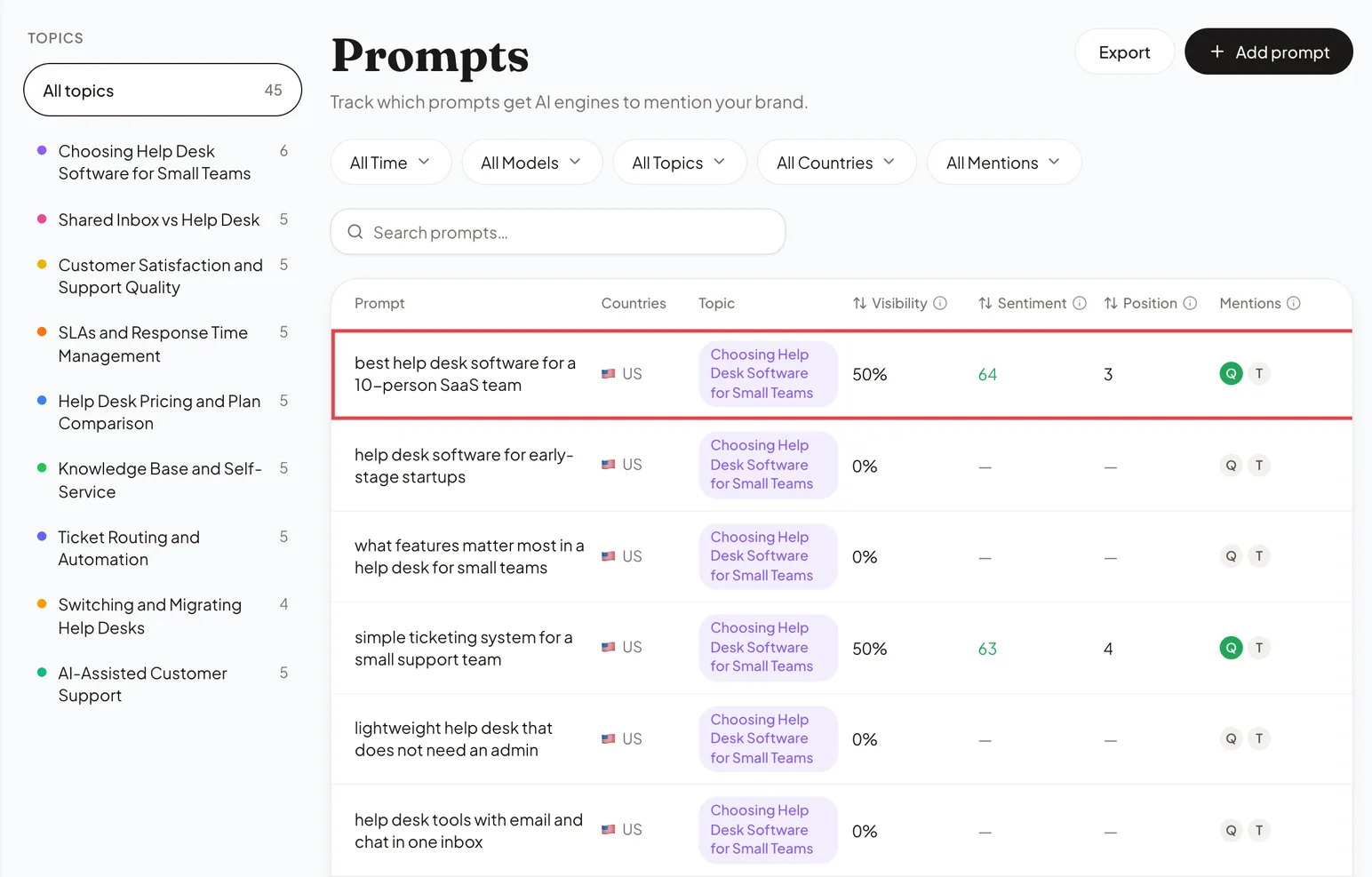
The keep and stop columns need no software: they are a backlog conversation and a deletion, both free. The start column has one item that becomes impractical by hand, repeated sampling: a fixed panel run five times across five engines every week is a thousand collections, and manual collection at that volume degrades in the way that ruins the arithmetic, by quietly skipping runs. Bavior runs a fixed prompt set across five engines on a schedule and records which sources each answer cited, which is what makes the acceptance tests above observable, and where a cited source is a live discussion thread it drafts a reply on an account you control for you to approve before anything posts. It does not do the keep column: it will not improve your rankings, fix your indexation, or write your pages. The free AI visibility check and the free GEO audit run without a paid plan; paid plans are from $99/mo billed monthly, or $79.17/mo billed annually (as of 29 Aug 2026).
Sources, all checked 29 Aug 2026
  1. “Optimizing Visibility in Generative Engines: A Critical Survey of Generative Engine Optimization (2023–2026)”, 15 Jul 2026, arXiv:2607.14035; confidence table and lever grades: arxiv.org/abs/2607.14035
  2. Puerto, Gubri, Green, Oh, Yun, “C-SEO Bench: Does Conversational SEO Work?”, NeurIPS 2025 Datasets & Benchmarks Track; ten methods, more than 1.9k queries and 16k documents, 54 cases: arxiv.org/abs/2506.11097
  3. Aggarwal, Murahari, Rajpurohit, Kalyan, Narasimhan, Deshpande, “GEO: Generative Engine Optimization”, KDD ’24; per-rank visibility table: arxiv.org/abs/2311.09735
  4. Kim et al., “SAGEO Arena”, KDD 2026 (arXiv:2602.12187v2, 7 Aug 2026); 171,003 documents, 2,700 queries, retrieval and reranking reinstated: arxiv.org/abs/2602.12187
  5. Pew Research Center, “Google users are less likely to click on links when an AI summary appears in the results”, 22 Jul 2025; 900 tracked adults, 68,879 searches, March 2025: pewresearch.org
  6. Jaźwińska & Chandrasekar, “AI Search Has a Citation Problem”, Tow Center for Digital Journalism, Columbia, 6 Mar 2025; 1,600 queries across eight engines: cjr.org
  7. Google Search Central, “AI features and your website”, updated 10 Dec 2025 (eligibility, query fan-out; first-party): developers.google.com/search/docs/appearance/ai-features
  8. Google Search Central, “Google’s Guide to Optimizing for Generative AI Features on Google Search”, updated 10 Jul 2026 (no AI text files, no special structured data; first-party): developers.google.com/search/docs/fundamentals/ai-optimization-guide
  9. Grossman et al., SIGIR 2026; 11,500 queries; URL-level Jaccard 0.11–0.18 across Google organic, AI Overviews and Gemini: arxiv.org/abs/2604.27790
  10. Sielinski, “Quantifying Uncertainty in AI Visibility”, Mar 2026, arXiv:2603.08924 (preprint): arxiv.org/abs/2603.08924
  11. Vishwakarma et al., 2026; 252,000-trial factorial finding effects for explicit prices and recent dates but weak effects for formatting changes alone (reported in the critical survey at note 1)
  12. Vendor study of 137,210 domains, published 15 June 2026; 97% of llms.txt files received zero requests, and no bots probed for llms.txt files that did not exist. Vendor-published; described rather than linked, per this curriculum's sourcing rule
  13. Vendor matched-control study of 1,885 pages that added JSON-LD between August 2025 and March 2026, against 4,000 control pages, measured over 30-day windows, published May 2026; AI Overview citations −4.6% (significant). Vendor-published; described rather than linked, as at note 12
FAQ

Frequently asked questions.

Do we need a separate GEO team?

No, and the evidence argues against it. Most of what improves AI visibility is ranking and retrievability work your search team already owns, and the largest controlled benchmark found context position, which is what ranking buys, worth 2.77 rank places in retail against 0.36 for the best content rewrite tested. A separate team creates a second backlog competing for the same pages. What genuinely needs an owner is the measurement cadence and the off-site work, and both are closer to a weekly ritual and a budget line than to a headcount.

What is the single highest-value change to make first?

Replace spot-checks with repeated sampling, because until that is in place you cannot evaluate anything else on the list. The 2026 critical survey reports repeat runs of the same query overlapping at Jaccard 0.34–0.42 and 9–28% of repeated decisions changing, and concludes that a point estimate is not a stable indicator. A team without repeated sampling will attribute engine drift to its own content work in both directions, which is worse than not measuring at all because it produces confident wrong decisions.

Should we stop publishing schema markup?

Keep shipping it, and remove the AI-citation justification from the ticket. The only matched-control test published, covering 1,885 pages that added JSON-LD matched against 4,000 controls over 30-day windows, found AI Overview citations down 4.6% with a significant result and no significant change elsewhere, and Google's own documentation states that no special structured data is needed to appear in its AI features. Schema still earns rich results and machine-readability, which were always the real reasons. Nothing about that changed; only the story attached to it did.

How long before any of this shows up in a number?

A quarter for most items, and never for some. Retrievability fixes are the fastest and the most binary: the URL either starts appearing in cited-source lists or it does not, usually within weeks. Ranking and content work show up as a change in a panel's citation rate over a quarter, because a weekly report does not carry enough observations to distinguish a small move from noise. Off-site work is slowest. And citations do not become sessions: independent tracking found people click a source inside an AI summary about 1% of the time.

Bavior Editorial

The team that researches and maintains Bavior’s writing on Reddit marketing and AI search visibility. Every figure here is attributed to a named source with the date it was checked, and none of our links are affiliate links.

Found a number that looks wrong? Tell us and we will re-check it: support@bavior.com

Keep the backlog. Change the report.
Start with a free baseline.

Start free trial