Home/Learn GEO/Community threads
Prompt research · Source 4 of 5

Why are community threads a prompt source and a target?

A thread title is a question a buyer wrote for other buyers, in public, with a date on it. The same page is often what an engine retrieves for that intent.

On this page
Share this
Share on X Share on LinkedIn
The short answer

A community thread title is a question a buyer wrote for other buyers, so it is a prompt you did not have to reconstruct, and the thread itself is often the page an engine retrieves when somebody asks it. That double use earns it a place in a prompt panel; its volatility is why it is capped at roughly 15% of one, after one assistant’s Reddit citation rate fell from about 60% of responses to about 10% in six weeks in 2025.8

Key takeaways
  • A thread title is already question-shaped, the phrasing that most reliably produces an AI answer: 64.7% Google AI Overview activation for question-form queries against 9.5% otherwise.1
  • Cited threads skew old, short and low-engagement in the largest published sample, so do not filter candidates by recency or by upvotes.
  • You can only find threads search already surfaced, and search overlaps weakly with what engines cite, so use the panel’s cited URLs as a second discovery channel.
  • Cap the slice at roughly 15% and report it separately: every specific number here is vendor-published, and one moved fifty points in six weeks.
The artefact

Why is a thread title a prompt?

Because someone with the problem wrote it as a question, for an audience with the same problem, and had to make it legible to strangers. That constraint separates a thread title from a question asked on a call: a forum poster edits the sentence so an unknown reader will follow it, which is exactly the self-contained, fully specified form a prompt needs.

It also arrives in the shape that most reliably produces an AI answer. An audit of 55,393 trending queries collected 13 March to 21 April 2026 measured Google AI Overview activation at 64.7% for question-form queries against 9.5% for the rest, a difference of 6.8 times.1 Thread titles are overwhelmingly question-phrased, so the source needs almost no normalisation: strip the slang a stranger would not follow, drop the “anyone else?”, and the sentence is ready.

What it does not carry is attribution. You know a human wrote it and roughly when; you do not know whether they were your buyer, a competitor, or someone long out of the market. That is why this source sits below your own calls and search console.
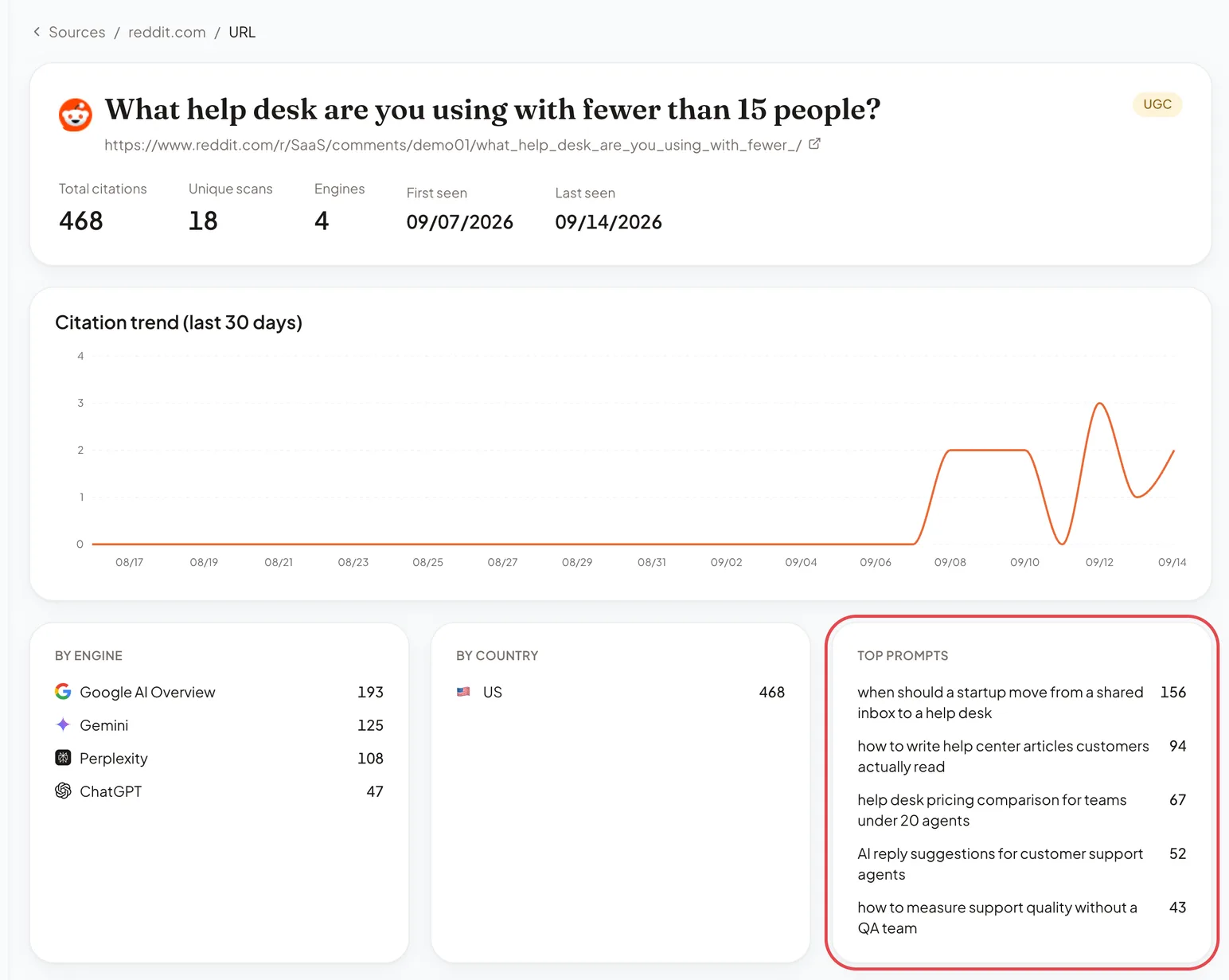
The double use

Why is this source useful twice?

Once as a question your panel measures, once as a page an engine may retrieve to answer it. The same thread is both instrument and competition.

01

As a panel entry

A buyer-written question needing no reconstruction, already phrased for a stranger and timestamped. It enters the panel with a source label and a date.

02

As a retrieval target

Cited community threads skew old, short and low-engagement rather than popular, so format and semantic match do the work, not upvotes.

03

As a place you can act

If an engine answers your buyer’s question with a thread, the correction lives in the thread, not on your site: off-site work, with its own rules and risks.

The best description of which threads get cited comes from a vendor study of November 2025 covering 248,000 cited Reddit URLs across 217,000 prompts: the cited threads averaged roughly 900 days old and about 80 words, more than half were question-and-answer in format, and 80% had fewer than 20 upvotes.2 The threads engines quote are not the popular ones: they are short, old and shaped like a question, the same profile the how AI search works stage describes for the rest of the web.

Set that against the only academic taxonomy of cited source types, which measured 21,143 search-layer citations from 602 controlled prompts and put official, news and vertical sources together at 79.12% to 87.52% of citations depending on platform.3 Community pages live in the remainder: they matter where buyers trust each other more than vendors, but they are not the bulk of what engines cite.

Selection

How do you choose which threads to take?

Take threads whose title is a question, posted by someone with the problem rather than someone selling a solution, in a forum your buyers read. Two further rules matter more than they look. Do not filter by recency: cited threads average around 900 days old, so an old thread is evidence of a durable question, not a stale one. Do not filter by engagement: 80% of cited threads carried fewer than 20 upvotes, so a quiet thread with a clear question beats a popular argument.

Then dedupe against what you already have, because this source overlaps heavily with your calls and produces the same question in better handwriting. When a thread title matches a call question, keep the call as the panel entry and log the thread as a variant with its URL: the call is attested to your buyer, the thread shows the question generalises beyond your funnel.

Coverage

Why is the thread you can find not the thread engines cite?

Because you find threads the way a person searches, and an engine does not retrieve that way. The survivorship problem has no fix, only a disclosure and a second channel.

You can only reach threads a search engine or a forum’s own ranking already surfaced, so your sample is the one that already won attention. Questions asked once in a quiet corner are invisible to you, and are exactly what a buyer might type into an assistant because nobody answered them.

The gap between searching and retrieval is measured, and it is large. A 4,706-query comparison of Google organic search against five generative systems, run from the US and Germany in September 2025, found that on average 53% of the domains Google’s AI Overview consults are absent from the top-10 organic results, and 27% from the top-100.4 A benchmark of 11,500 queries across Google organic search, AI Overviews and Gemini reports URL-level Jaccard similarities between 0.11 and 0.18.5 Both measure domains and URLs in general, not forums, so read them as a bound on the method rather than a fact about threads: what you find by searching is a weak proxy for what an engine retrieves.

So discovery has to run in both directions. Collect thread titles by hand, then let the panel do the second pass: every run records the URLs each engine cited, and a community thread in that list is one the engine reaches and you did not. Note the selection bias in your panel documentation.

The trap

What is the trap in this source?

Believing the community citation rate is a stable property of the engines. It is the most volatile series in this field, and the most misquoted.

Figure you will see quotedWhat it actually measuresStatus
“Reddit is 40.1% of AI citations”A presence rate from a chart, relabelled as a share of citationsBroken: the values sum to about 208%, so they were never shares
Reddit present in 13% / 9% / 4% of responsesPresence rate per response, three engines, one vendor, late 2025Defensible with a date attached
Reddit 1.8% to 6.6% of citationsShare of citation volume, 680 million citations, Aug 2024 – Jun 2025A different denominator
Community citation rate falling ~60% to ~10%One assistant’s Reddit citation rate over Aug–Sep 2025Why no figure here is a constant

The widely repeated claim that Reddit is 40.1% of AI citations does not survive contact with its own source: the number traces to a chart of per-engine presence rates relabelled as a share of total citations, and the values sum to roughly 208%, which no set of shares can do.6 The same vendor’s later, much larger study puts Reddit’s presence at 4% to 13% of responses, and an independent 680-million-citation dataset for August 2024 to June 2025 puts Reddit at 1.8% to 6.6% of citation volume.27 Presence rate and citation share have different denominators, and quoting either without saying which is not measurement.

The volatility is the more useful warning. A vendor time series of 230,000 prompts and more than 100 million citations, collected 14 July to 12 October 2025, recorded one assistant’s Reddit citation rate falling from roughly 60% of responses to roughly 10% over August to mid-September 2025.8 A fifty-point move in six weeks is a retrieval policy change, not a market shift, and a panel weighted toward community questions registers it as a change in your visibility. The 2026 critical survey rates “commercial engines differ from one another and vary over time” at high confidence: visibility is indexed by engine and surface.9

A second trap costs less and happens more: collecting threads you could plausibly reply to rather than the questions your buyers ask. Selecting entries by your ability to act on them guarantees the only gaps you find are ones you knew about.

Composition

How many community prompts belong in the panel?

Roughly 15%, about six entries in a 40-prompt panel: enough to cover the questions where buyers trust each other more than vendors, and small enough that a shift in one engine’s treatment of forums cannot dominate your number. The reasoning matters more than the number: this is the only source whose measurement properties depend on a third party’s retrieval policy, and that policy has moved fifty points in six weeks once.

Report these entries as their own slice as well as in the panel total. Citation distributions follow a power law, which makes small subgroups noisy, and the 2026 statistical treatment of AI visibility is explicit that many apparent differences between domains fall within the noise floor of the measurement process.10 Six prompts run five times is 30 observations per engine per period: treat movement there as a signal to read the answers, not a number to report.

When the panel shows an engine answering your buyers with a community thread, the work that follows is off-site, under constraints your own pages do not have. Many subreddits require you to disclose a commercial affiliation in the comment itself, each subreddit’s rules page is the authority on what counts, and a moderator can remove what you post. Reply as yourself where you can answer honestly, and never buy votes, run second accounts or organise agreement: that is manipulation, and the fastest way to lose the account. The off-site GEO stage has the mechanics, and the source ranking covers how this slice fits with the other four.

The honest limit of this article

Almost everything specific about cited threads here is vendor-published: the 900-day age, the 80-word median, the upvote distribution and the fall from 60% to 10% all come from companies that sell AI-visibility tooling, with disclosed samples, undisclosed methods, and no independent replication. The academic sources have limits too: the taxonomy at note 3 reports descriptive statistics only, and the studies at notes 4 and 5 measure domains and URLs in general, not forums. Treat any percentage here as accurate for the month it was measured and no longer.

Where a product fits, and where it does not

Collecting this source is free and tedious: sort the forums your buyers read by relevance rather than popularity, take the titles that are questions, and dedupe against your call questions. An hour gives you six panel entries and a reading list. Bavior does not choose which threads matter, cannot tell you whether a thread’s author was your buyer, and cannot make an engine cite a community page or stop it citing one. What it does is watch the consequence: a fixed panel across five engines on a schedule, every cited URL recorded, so you see when your buyer’s answer comes from a thread rather than a page. Where that source is a live thread, it drafts a reply on an account you control, which you approve before it posts. The free AI visibility check and the free GEO audit run without a paid plan; paid plans are from $99/mo billed monthly, or $79.17/mo billed annually (as of 29 Aug 2026).

Sources, primary re-checked 30 Aug 2026. Vendor items are described, not linked.
  1. Xu, Iqbal & Montgomery, “Measuring Google AI Overviews”, 2026; 55,393 trending queries, 13 March to 21 April 2026; activation 64.7% for question-form queries against 9.5% otherwise (preprint): arxiv.org/abs/2605.14021
  2. Community-thread citation study, November 2025: 248,000 cited Reddit URLs across 217,000 prompts; cited threads ~900 days old, ~80 words, 80% under 20 upvotes; Reddit present in 13%, 9% and 4% of responses.
  3. Zhang, He & Yao, “From Citation Selection to Citation Absorption”, Apr 2026, arXiv:2604.25707; 602 prompts, 21,143 search-layer citations; official, news and vertical sources 79.12% to 87.52% of citations (preprint, descriptive statistics only): arxiv.org/abs/2604.25707
  4. Kirsten et al., “Characterizing Web Search in The Age of Generative AI”, Findings of ACL 2026; 4,706 queries, US and Germany, September 2025; “on average 53% (27%) of domains that AIO consults are not contained in top-10 (top-100) Organic search results”: aclanthology.org/2026.findings-acl.526
  5. Grossman et al., “How Generative AI Disrupts Search”, SIGIR 2026, arXiv:2604.27790; 11,500 queries; “Jaccard similarities between 0.11 and 0.18” across Google organic search, AI Overviews and Gemini: arxiv.org/abs/2604.27790
  6. The “40.1%” figure: a July 2025 vendor chart of per-engine presence rates, relabelled in secondary coverage as a share of total citations; the published values sum to about 208%.
  7. Citation-share study, June 2025 (updated August 2025): 680 million citations, August 2024 to June 2025; Reddit 1.8% of one assistant’s citations, 2.2% of Google AI Overview’s, 6.6% of Perplexity’s.
  8. Most-cited-domains time series, November 2025: 230,000 prompts, more than 100 million citations, 14 July to 12 October 2025; one assistant’s Reddit citation rate fell from roughly 60% of responses to roughly 10% over August to mid-September 2025.
  9. Martinez, “Optimizing Visibility in Generative Engines: A Critical Survey”, 15 Jul 2026, arXiv:2607.14035 (“Commercial engines differ from one another and vary over time”, rated high confidence; “Visibility is indexed by engine and surface”): arxiv.org/abs/2607.14035
  10. Sielinski, “Quantifying Uncertainty in AI Visibility”, Mar 2026, arXiv:2603.08924 (citation distributions follow a power-law form; differences between domains often fall within the noise floor): arxiv.org/abs/2603.08924
FAQ

Frequently asked questions.

Do I need a big subreddit for a thread to be worth taking?

No. Size and popularity are close to irrelevant to whether a thread gets cited, in the largest published sample. That study of 248,000 cited Reddit URLs found the cited threads averaged around 900 days old and about 80 words, with 80% carrying fewer than 20 upvotes and more than half in question-and-answer format. Format and semantic match to the question are what the data associates with citation, not engagement. For prompt research the implication is simpler still: you are taking the title as a question, so a quiet thread with a clearly phrased question is a better source than a popular argument.

Is "Reddit is 40 percent of AI citations" true?

No. That figure traces to a July 2025 chart of per-engine presence rates that was relabelled as a share of total citations; the published values in it sum to roughly 208%, which no set of shares can do. The same vendor's later 248,000-URL study measured Reddit's presence at 4% to 13% of responses depending on the engine, and a separate 680-million-citation dataset covering August 2024 to June 2025 put Reddit at 1.8% to 6.6% of citation volume. Always ask which denominator a percentage uses, because presence per response and share of all citations are different questions with wildly different answers.

Should I reply in every thread the panel finds?

Only where you can answer the question honestly as yourself, and the panel's job is to find them rather than to justify replying. If an engine answers your buyer's question with a community thread, the correction lives in that thread rather than on your site, which makes it off-site work with its own constraints: many subreddits require you to disclose a commercial affiliation, each subreddit's rules page is the authority on what counts, and a moderator can remove what you post. Treat a thread the panel surfaces as a candidate for a genuine reply, never as an obligation.

How stable are community citation rates over time?

Less stable than anything else measured in this field, which is the main reason to cap this slice of the panel. A vendor time series built from 230,000 prompts and over 100 million citations, collected 14 July to 12 October 2025, recorded one assistant's Reddit citation rate falling from roughly 60% of responses to roughly 10% between early August and mid-September 2025. A fifty-point move in six weeks is a change in retrieval policy, not in your visibility, and a panel weighted toward community questions will report it as though it were yours.

Bavior Editorial

The team that researches and maintains Bavior’s writing on Reddit marketing and AI search visibility. Every figure here is attributed to a named source with the date it was checked, and none of our links are affiliate links.

Found a number that looks wrong? Tell us and we will re-check it: support@bavior.com

Your buyers ask each other in public.
Read what they typed.

Start free trial