How does a community thread get selected into an AI answer?
Through the ordinary retrieval pipeline, with one difference that decides everything: on a forum, every gate in front of the page belongs to somebody else.
Off-site GEO topic12 min readUpdated 30 Aug 202611 sources, all primary
A community thread is selected by the same pipeline as any other page: it has to be indexed and fetchable, it has to match one of the sub-queries the engine generated rather than the question a person typed, and it has to survive a reranker nobody outside the engine can inspect. What differs is ownership, not mechanism, because every one of those gates belongs to the platform hosting the thread. Across 4,706 queries collected in September 2025, 53% of the domains a Google AI Overview consults were absent from the organic top ten and 27% from the top hundred, so a thread’s rank in ordinary search says little about whether an engine will reach it.3
Key takeaways
Selection is search: Google states its generative features are “rooted in our core Search ranking and quality systems”, and a supporting link “must be indexed and eligible to be shown in Google Search with a snippet”.12
The unit of matching is a generated sub-query, so a thread is picked up for one facet of an answer rather than for your category.
Writing to be selected barely works: 3 significant results out of 54 cases in a NeurIPS 2025 benchmark, and ten body-text strategies all below baseline at KDD 2026.67
Being cited is neither being represented nor being visited: 51.5% of generated sentences were fully supported by their citations, and 1% of visits produced a click on a summary’s source.810
Eligibility
What has to be true before a thread can be selected?
Four things, and none of them concern how good the thread is. It has to sit in the engine’s index or be fetchable at question time; the platform hosting it has to permit that fetch; the URL has to still return the text that was crawled; and some passage has to be relevant to a query the engine actually issued. Google states the first requirement plainly: to be eligible as a supporting link, a page “must be indexed and eligible to be shown in Google Search with a snippet, fulfilling the Search technical requirements” (page last updated 10 December 2025).1
On your own site each is a configuration you can change in an afternoon, the whole subject of the retrieval stage. On a thread, none of them are yours. You are contributing text to an asset another organisation operates, and its retrieval properties are that organisation’s product decisions.
01
The host’s index settings
Indexability and snippet eligibility are set in the platform’s own markup and headers. A community that noindexes old archives removes years of threads from every engine reading it.
02
The host’s crawler policy
A benchmark of 11,500 queries found sites blocking Google’s AI crawler were significantly less likely to be retrieved by AI Overviews, despite the system having access to the content.4 That policy is one file, and it is not on your roadmap.
03
Whether the URL survives
A removed comment, a locked thread, a private community or a deleted account each break the citation. Among URLs engines had already cited, a 2026 measurement found 27.1% could not be scraped at all.11
The unit of matching
Which question is a thread matched against?
Not the one your buyer typed. Retrieval runs once per generated sub-query.
Google documents the mechanism on its own surfaces: AI Overviews and AI Mode “may use a ‘query fan-out’ technique, issuing multiple related searches across subtopics and data sources, to develop a response”.1 A thread about migrating off one specific tool is competing for the migration sub-question, and can win that fragment while ranking nowhere for anything a person would type.
The measured consequence is that a candidate set is not a page of search results. A 4,706-query audit of AI Overviews published in Findings of ACL 2026, on data collected in September 2025, reports that “on average 53% (27%) of domains that AIO consults are not contained in top-10 (top-100) Organic search results”.3 A larger preprint, 55,393 trending queries collected between 13 March and 21 April 2026, found 29.8% of AI Overview reference domains absent from the corresponding first page.5 The verbs differ, consulted against referenced, so read the pair as a range.
Google’s own sentence, that “our generative AI features on Google Search are rooted in our core Search ranking and quality systems” (page last updated 10 July 2026), does not conflict with that.2 Ranking is the substrate candidates are drawn from; the candidate set is assembled per sub-query and is not the list a person would have seen. For thread work: whether a thread tops the forum’s own sort order is close to irrelevant; whether one passage answers a narrow sub-question literally is what decides. Why the threads you can find by searching are a biased sample is the subject of the companion article on threads as a prompt source.
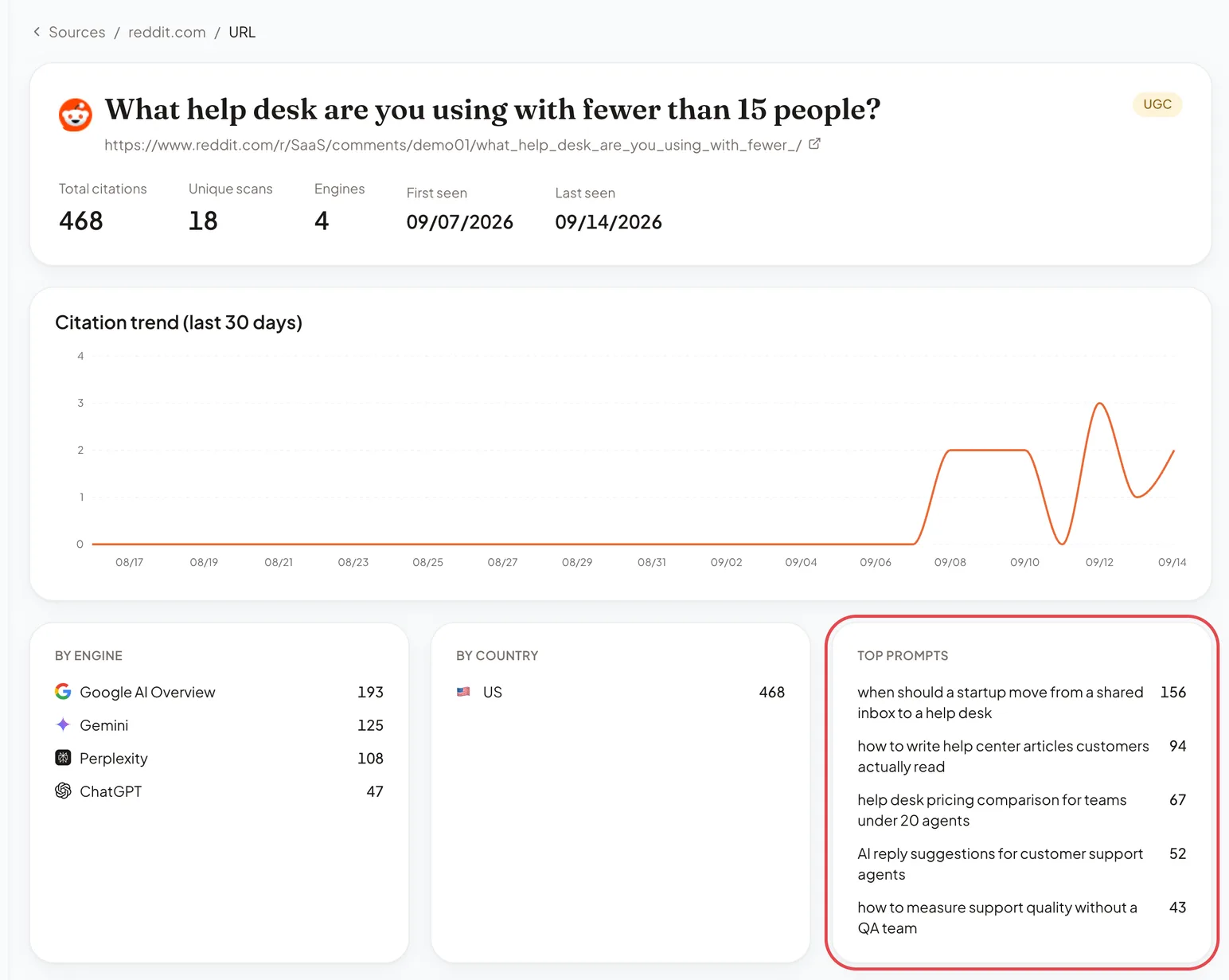
To see which of your own questions a thread is cited for, open it in Bavior from Sources. Top prompts lists the tracked prompts that led engines to cite that one thread, so judge it question by question rather than by its title.
Sample data from a demo workspace. Thread titles are illustrative, not real Reddit posts. The red box marks Top prompts, the tracked prompts this one thread was cited for.
The limits of writing
Can you write a reply so that it gets selected?
Barely. The two benchmarks that tested content-side optimisation found it ineffective, and the one that also ran retrieval found it harmful.
What people try
What the measurement found
Verdict
Rewriting the passage to read as authoritative
Ten content methods, 54 cases, 3 significant improvements
No reliable effect
Body-text optimisation strategies
Ten strategies, all three reported averages below baseline
Negative on average
Earning a better position in the context
2.77 places of citation rank (sd 2.31) against 0.36 (sd 1.47)
Strongest published lever, not a writing technique
C-SEO Bench, a NeurIPS 2025 Datasets and Benchmarks paper covering more than 1.9k queries and 16k documents, tested ten methods and concluded that “most current C-SEO methods are not only largely ineffective but also frequently have a negative impact on document ranking, which is opposite to what is expected”. Its section 6.2 is blunter: “Out of 54 cases, we uncover only three where the ranking improvements are statistically significant.”6
SAGEO Arena, accepted at KDD 2026, reaches the same place through a pipeline that keeps retrieval and reranking in scope. Ten strategies applied to body text alone produced averages of 0.53, 0.84 and 0.47 against baselines of 0.58, 1.00 and 0.50, so all three moved down, and the paper reports that existing approaches “often degrade performance in retrieval and reranking”.7
What survives that evidence is unglamorous and worth doing anyway. Answer the question the thread actually asks, in the first sentence, at a length a stranger will read. Disclose a commercial interest: many communities require it in their own rules, each community’s rules page is the authority on what counts there, and an undisclosed vendor answer is the one a moderator removes. Never buy votes, run second accounts or organise agreement: that is manipulation, it ends the account rather than the campaign. None of this is a selection technique; it is the price of being allowed to leave text where an engine might find it.
Representation
If a thread is selected, does the answer say what it says?
Often not exactly. The foundational audit of citation quality in generative search, published in Findings of EMNLP 2023, found that “on average, a mere 51.5% of generated sentences are fully supported by citations and only 74.5% of citations support their associated sentence”.8 The 55,393-query preprint measures the same failure at claim level, reporting 11.0% of 98,020 atomic claims as unsupported.5
The largest independent test is the Tow Center’s, which put sixteen hundred queries to eight engines and found they answered “more than 60 percent of queries” incorrectly. The worst engine got 94 percent of the queries wrong, and of the 200 prompts tested for it, 154 citations led to error pages (checked 30 August 2026).9 Keep that denominator straight: 200 counts prompts, not citations.
For off-site work the implication is specific: your reply being the cited source does not mean your sentence is the sentence a reader sees, and a link to the thread is not evidence that it was read correctly. Read the answer text, then the citation list, and treat disagreement between them as the normal case. Citation accuracy covers how far that gap has been measured.
Consequence
Does being the cited thread bring anyone to you?
Rarely, on the only large behavioural measurement in public. Pew Research Center tracked the browsing of 900 US adults across 68,879 unique Google searches in March 2025 and found a link inside an AI summary was clicked “in just 1% of all visits” to pages carrying one (checked 30 August 2026).10 That is one country, one engine and one month, and still the cleanest number in the field.
The 2026 critical survey rates the claim that citation scores predict clicks, conversions or revenue at very low confidence.11 A cited thread is worth having for a different reason: it is what an engine tells your buyer while your buyer never visits you. Measure it as a share of the answer rather than as a traffic channel, which is what the metrics article argues.
Repeatability
How repeatable is one thread’s selection?
Not very, and the instability sits at the level of individual sources rather than the overall picture. The 11,500-query SIGIR 2026 benchmark observes that AI Overviews “are less consistent when processing two runs of the same query, and are less robust to minor query edits”.4 The 2026 critical survey reports repeated runs at temperature zero changing 9% to 28% of decisions, and a four-engine study repeating the same queries daily for 45 days measuring source-level Jaccard between consecutive days of 0.34 to 0.42, on a small Swiss query universe.11
One observation of one answer is therefore not evidence about a thread. This site reports proportions with a 95% Wilson interval, whose half-width at p of 0.5 is 1.96 divided by twice the square root of (n plus 3.84): five runs give roughly plus or minus 33 points, thirty runs plus or minus 17, two hundred plus or minus 7. A claim that a thread now gets selected more often has to survive that interval, which means logging cited URLs on a schedule rather than checking by hand twice. Statistical power works the arithmetic through.
The honest limit of this article
No primary study measures community threads as a source class. Every mechanism claim above is measured on the open web at large and applied to threads by argument, not by direct observation. The numbers usually quoted about cited threads, their age, length and upvote counts, are vendor-published with undisclosed methods; the companion article handles them and this one deliberately carries none. Three sources here are preprints, and the audit at note 8 measures four engines since retired or rebuilt. Nothing here establishes that a reply you write will be selected.
Where a product fits, and where it does not
Bavior cannot make an engine select a thread, cannot get a removed post restored, cannot change a community’s crawler or indexing policy, and does not know whether a thread’s author was ever your buyer. What it does instead is record the consequence often enough to mean something: a fixed prompt set across five engines on a schedule, with every cited URL logged, so you see when a thread rather than one of your pages answers your buyers, and how often. Where a cited source is a live thread, Bavior drafts a reply on an account you control, under that community’s own rules, which you approve before anything posts; it does not touch votes. The free AI visibility check and the free GEO audit run without a paid plan; paid plans are from $99/mo billed monthly, or $79.17/mo billed annually (as of 30 Aug 2026).
Sources, all primary, all re-checked 30 Aug 2026
Google Search Central, “AI features and your website”, last updated 10 Dec 2025 (snippet eligibility; query fan-out; first-party): developers.google.com/search/docs/appearance/ai-features
Google Search Central, “Google’s Guide to Optimizing for Generative AI Features on Google Search”, last updated 10 Jul 2026 (the “rooted in” sentence; first-party): developers.google.com/search/docs/fundamentals/ai-optimization-guide
Kirsten et al., “Characterizing Web Search in The Age of Generative AI”, Findings of ACL 2026; 4,706 queries, Sept 2025; “53% (27%) of domains that AIO consults are not contained in top-10 (top-100) Organic search results”: aclanthology.org/2026.findings-acl.526
Grossman et al., “How Generative AI Disrupts Search”, SIGIR 2026, arXiv:2604.27790; 11,500 queries; AI-crawler blocking reduces AIO retrieval; AIOs inconsistent across two runs of one query: arxiv.org/abs/2604.27790
Xu, Iqbal & Montgomery, “Measuring Google AI Overviews”, 2026 preprint; 55,393 trending queries, 13 Mar to 21 Apr 2026; 29.8% of reference domains absent from the first page; 11.0% of 98,020 atomic claims unsupported: arxiv.org/abs/2605.14021
Puerto et al., “C-SEO Bench: Does Conversational SEO Work?”, NeurIPS 2025 Datasets & Benchmarks, arXiv:2506.11097; ten methods; §6.2 “Out of 54 cases, we uncover only three where the ranking improvements are statistically significant”; Table 3 retail 2.77 ±2.31 vs 0.36 ±1.47: arxiv.org/abs/2506.11097
“SAGEO Arena”, arXiv:2602.12187v2, KDD 2026; Table 2 “Body Text only” averages 0.53, 0.84, 0.47 vs baselines 0.58, 1.00, 0.50, ten strategies: arxiv.org/abs/2602.12187
Liu, Zhang & Liang, “Evaluating Verifiability in Generative Search Engines”, Findings of EMNLP 2023, arXiv:2304.09848; “a mere 51.5% of generated sentences are fully supported by citations and only 74.5% of citations support their associated sentence”: arxiv.org/abs/2304.09848
Jaźwińska & Chandrasekar, “AI Search Has a Citation Problem”, Tow Center for Digital Journalism; sixteen hundred queries, eight engines; more than 60 percent answered incorrectly; worst engine 94 percent, 154 error-page citations out of 200 prompts: cjr.org/tow_center
Pew Research Center, “Google users are less likely to click on links when an AI summary appears in the results”, 22 Jul 2025; 900 US adults, 68,879 searches, March 2025; “in just 1% of all visits”: pewresearch.org/short-reads/2025/07/22
“Optimizing Visibility in Generative Engines: A Critical Survey”, 15 Jul 2026, arXiv:2607.14035 (preprint); reports 27.1% of cited URLs unscrapable (Allaham & Diakopoulos), 9% to 28% of decisions changing at temperature zero (Kirsten et al.), daily Jaccard 0.34 to 0.42 over 45 days (Schulte et al.), and a very low rating for citation scores predicting clicks or revenue: arxiv.org/abs/2607.14035
Does a thread need to rank in Google before an engine will cite it?
No, and its rank predicts less than most people expect. A 4,706-query audit published in Findings of ACL 2026 found that on average 53% of the domains an AI Overview consults are absent from the organic top ten for that query, and 27% from the top hundred. Query fan-out is the reason: retrieval runs per generated sub-query, so a thread can be a strong candidate for one fragment of a question while ranking nowhere for the question itself.
Can I write a reply that makes an engine cite me?
The published evidence says no reliable technique exists. C-SEO Bench, a NeurIPS 2025 benchmark of ten content methods, found only three statistically significant ranking improvements out of 54 cases, and reported that most methods frequently hurt ranking instead. SAGEO Arena at KDD 2026 applied ten strategies to body text and saw all three of its reported averages fall below baseline. Answer the question well, disclose your interest under the community's rules, and treat selection as something you observe rather than something you buy.
If my reply is the cited source, is my point what the answer says?
Not reliably. The Findings of EMNLP 2023 audit of generative search found that only 51.5% of generated sentences were fully supported by their citations and only 74.5% of citations supported the sentence attached to them. A 2026 preprint measured 11.0% of 98,020 atomic claims in AI Overviews as unsupported. Read the answer text rather than the citation list, and expect the two to disagree often enough that disagreement is the normal case.
How many runs do I need before a change in thread citations is real?
More than a spot check. Repeated runs at temperature zero have been measured changing 9% to 28% of decisions, and a four-engine study running the same queries daily for 45 days saw source-level overlap between consecutive days of 0.34 to 0.42. Using a 95% Wilson interval, five runs give roughly plus or minus 33 points, thirty runs plus or minus 17, and two hundred runs plus or minus 7. Log cited URLs on a schedule and record the product, mode, date, locale and account with each one.