An AI visibility monitoring tool asks the engines a fixed panel of buyer questions on a schedule, then reports how often the answer names you and which URLs it cited. That is a reading, not a lever. The documents those answers are built from are mostly not yours: in two counts published 2 Sep 2026, reddit.com is the most-cited domain in ChatGPT answers at 16.8%,1 and second in Google AI Overviews at 18.5% behind youtube.com.2
Key takeaways
A score moves when somebody publishes something, usually not you. Monitoring reports the move, it does not cause it.
The same brand reads differently on every dashboard: Reddit’s share of ChatGPT citations is printed as 16.8% by one vendor and 0.52% by another, four weeks apart.14
A critical survey of 45 studies reports no technique with a stable cross-platform effect on discoverability, so read any promised lift as unmeasured.5
The category
What does an AI visibility monitoring tool actually do?
Three jobs, and the price gaps across the category are mostly gaps in how much of each you get. A prompt panel, the questions it asks. Engine coverage, which assistants it asks. And citation attribution, the URLs each answer leaned on.
Three published plan tables, read on 12 Sep 2026, show the shape. Otterly.ai opens at $29/mo for 15 search prompts across ChatGPT, Google AI Overviews, Perplexity and Microsoft Copilot, then $189 for 100 prompts and $489 for 400, with Claude, Gemini and Google AI Mode sold as add-ons.10Profound opens at $99/mo on annual billing for 50 tracked prompts and ChatGPT only, and keeps nine-engine coverage for a quoted Enterprise tier.9Frase arrives from the content side, bundling AI Visibility into a writing and auditing product from $49/mo on ChatGPT and Google AI.11
What comes out is a report. Otterly’s own list of outputs summarises the category: brand mentions, average position, the links each answer cited, sentiment and share of voice, plus briefs you implement yourself.10
None of that is a criticism. A fixed panel on a schedule is the only honest way to learn whether an assistant names you. This article starts one step later, when the number is low and the tool has said everything it was built to say.
The score problem
Why does a visibility score not tell you what to change?
Because it aggregates thousands of retrieval decisions over documents you did not write. When it falls, the cause is usually somebody else publishing, or the engine reaching into a different index. A dashboard shows the delta, not the sentence that caused it.
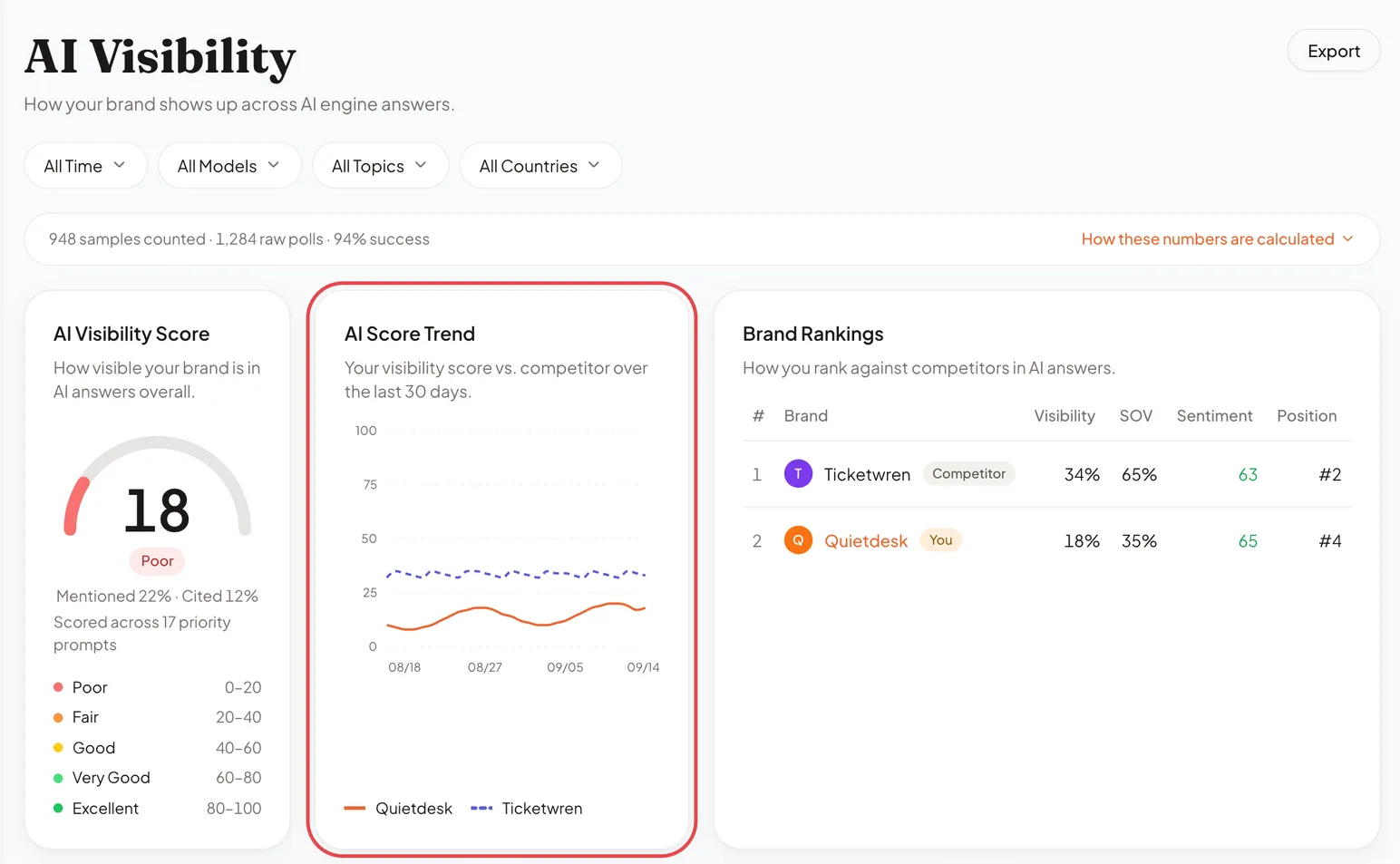
Open AI Visibility in Bavior and the AI Score Trend card is exactly that: your score against one competitor for 30 days, with no sentence behind either line.
Sample data from a demo workspace. The lines are demo data and say nothing about cause. Red box: the AI Score Trend card.
The sharpest demonstration is what happens when several serious teams measure the same object. Ahrefs, on US queries in September 2026, puts reddit.com first among domains cited in ChatGPT at 16.8%1 and second in Google AI Overviews at 18.5%.2 Semrush, across 217,000 prompts published 10 Nov 2025, reports Reddit links in 12.6% of SearchGPT answers, 9% of Google AI Mode responses and 3.5% of Perplexity answers.3 Promptwatch, via Search Engine Land on 19 Aug 2026, measured 3.83% of ChatGPT Search citations from 18 Jul to 7 Aug 2026, falling to 0.52% through 17 Aug.4 One domain, one quarter, four numbers between 0.52% and 18.5%.
They are not arguing about reality. They count different surfaces, engines and windows, which is the point: a vendor score is one instrument’s reading, and its movement mixes your work, everyone else’s, and the instrument. The critical survey of 45 studies agrees: “no reviewed technique shows a stable, longitudinal, cross-platform causal effect on organic discoverability”.5
Priya, a solo founder selling a $49/mo scheduling tool, bought a $29 tracker and watched her mention share drift from 4% to 11% and back to 5% across eleven weeks. She is an illustrative composite, and the pattern is common: she changed nothing. A competitor got written up, an old thread rose, the engine shipped an update. Her $377 bought a chart of other people’s publishing.
The honest limit of everything here
Nobody has shown that any technique raises a score reliably across engines and over time.5 What the citation data supports is narrower: the documents an answer is built from are identifiable, most are not yours, and the pages absorbed rather than listed carry definitions, numbers and comparisons.6 Read a guaranteed lift as unmeasured.
The evidence
Which sources do AI answers actually cite?
Community and platform domains in volume, plus a long tail of editorial pages. Ahrefs’ September 2026 read of more than 3 million US queries puts youtube.com at 22.9% of Google AI Overviews mentions, reddit.com at 18.5%, facebook.com at 10.1%.2 In ChatGPT the order shifts and the shape holds: reddit.com 16.8%, en.wikipedia.org 7.0%.1 Vendor domains appear one brand at a time, split across the category.
Being cited and being used are different events. A framework published in April 2026, on 602 prompts and 21,143 search-layer citations, separates citation selection from absorption and finds the pages contributing most to the finished answer “tend to be longer, more structured, semantically aligned, and richer in extractable evidence such as definitions, numerical facts, comparisons, and procedural steps”.6
Google closes the other door. Its page on AI features states “there are no additional requirements to appear in AI Overviews or AI Mode, nor other special optimizations necessary”.7 There is no switch, only the work of being the best document on the question and being present in the documents other people write.
Four routes
What does execution look like after the dashboard?
Four kinds of work, sorted by who owns the page that has to change.
Community threads the answers already cite
The fastest route, because the thread exists and the engine already reaches for it. Find the threads cited for your buying questions, then answer what is actually asked, on an account you control. Where a subreddit requires disclosure, disclose.
Earned mentions on editorial domains
Roundups, category explainers and press sit in the long tail behind the platform domains, and they are what an engine reaches for when it needs a comparison it cannot build out of vendor pages. No dashboard toggles this.
First-party pages that supply checkable facts
Your pricing, limits and constraints are the raw material every third-party page and every answer draws on, so publish them plainly and keep them current. Google is explicit that no special markup is required, so treat structured data as clarity, not leverage.7
Corrections to pages that already rank
The highest return per hour here, and the one nobody puts on a calendar. When a widely cited roundup carries your price wrong, that wrong fact gets absorbed. Email the author the correct figure and a link that proves it, then re-run the prompt.
Marcus, the head of growth at a 20-person analytics company, is a composite who ran the first route badly before he ran it well. He posted a launch announcement into a subreddit from a two-week-old account with 3 karma, and a mod removed it inside the hour. A year later he spent six weeks answering questions with no link attached, and the comment that landed on a “what do you use to track client work” thread is still the page his category’s answers cite.
None of the four is a setting inside a monitoring tool. The gap is in job description, not software quality.
The loop
How does Bavior close the loop between monitoring and execution?
By running both halves against the same prompt panel. Bavior asks a fixed set of your buyer questions across five engines on a schedule and records which sources each answer cited, which is the monitoring half. The difference is what happens next: where a cited source is a live community thread, Bavior drafts a reply in your voice on an account you control, and that draft waits in an approval queue. Nothing publishes without approval, from either Bavior’s aged high-karma accounts or your own account.
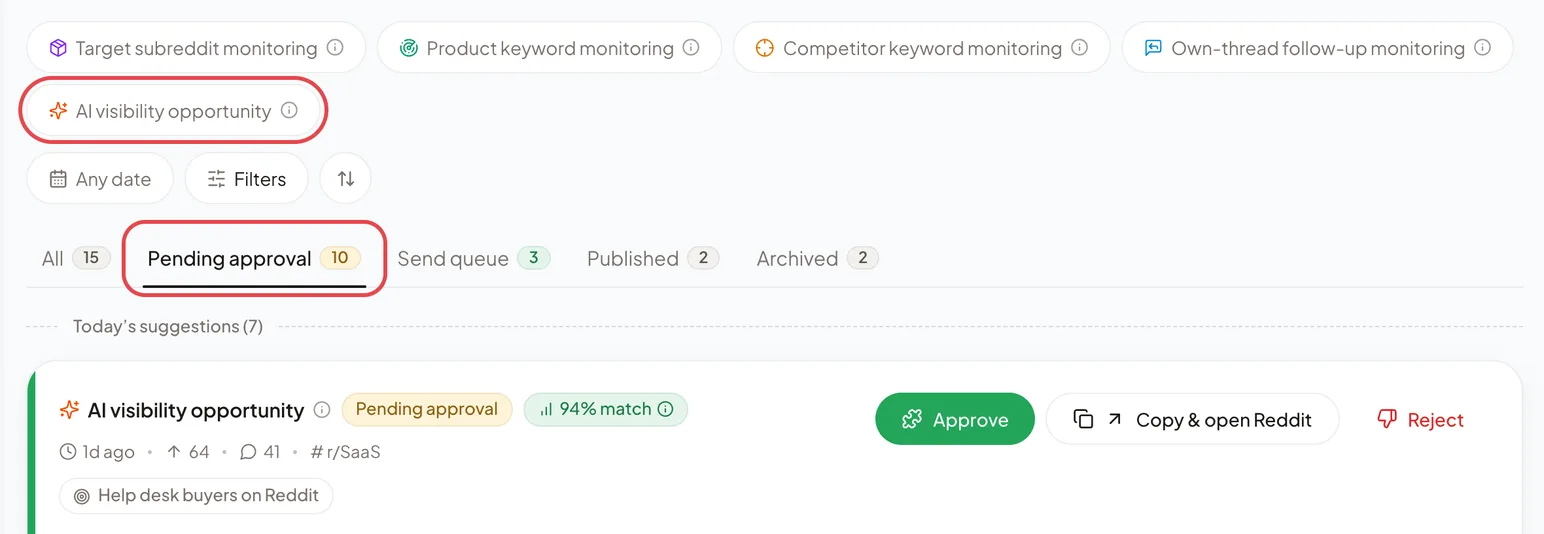
Open Comment suggestions to work that queue. Every monitoring source feeds it, AI visibility opportunity included, and each draft sits under Pending approval until you choose Approve or Reject. Once you approve an item you delegate for sending, a human operator schedules and sends it through accounts Bavior provides. To post it yourself instead, use Copy & open Reddit.
Sample data from a demo workspace. Red boxes: the AI visibility opportunity source filter and the Pending approval tab.
What it does not do is worth stating plainly. It cannot place you in a roundup, contact a publisher or arrange an inclusion, and it does not promise a comment will be cited, because inclusion is the engine’s decision.5 It changes the part you control: whether a good answer from you exists on the page the engine already reads. Results come back as mention share, citation share and share of voice. The AI SEO page has the mechanics, and the approval page covers what the queue blocks.
Pricing is $99/mo billed monthly, or $79.17/mo annually, the same entry point as Profound’s Starter tier and above Otterly’s Lite.910 The comparison worth making is not price against price, but what each leaves on your desk at month end.
Side by side
What do monitoring tools ship, and what does Bavior ship?
One disclosure first: Bavior is our own product, and it sits in the first column because we put it there. Every competitor row was read off that company’s own live pages on 12 Sep 2026, so check the rows that matter against their pages.
What you get
Bavior
Profound
Otterly.ai
Frase
Published entry price
$99/mo, $79.17/mo annual
$99/mo billed yearly
$29/mo
$49/mo, $39/mo annual
Prompts at entry
Fixed panel, set with you
50 tracked
15 search prompts
No cap published
Engines at entry
Five
ChatGPT only
Four
ChatGPT, Google AI
Reports the cited URLs
Yes
Yes
Yes
Yes
Acts on a page you do not own
Yes, cited threads
No
No, briefs only
No
Writes for your own domain
Not the product
No
Content briefs
Yes, 10 articles/mo
Approval before anything posts
Required, every item
Nothing is posted
Nothing is posted
Publishes to your CMS
Read the last three rows together. All four measure. One also answers the thread the measurement points at, one writes for the domain you own. Three jobs under one category name, which is how teams buy on engine count.
The decision
Who should buy monitoring, and who should buy execution?
It turns on one question: when the report lands, whose calendar has the follow-up on it?
Nobody owns the follow-up yet
Buy monitoring, cheap. Otterly’s $29 tier answers “are we named at all” for a year at the price of one agency hour.10
You report the number upward
Buy depth. Profound’s $399 tier covers 100 prompts across three answer engines, and its Enterprise tier is where nine-engine reporting lives.9
The answers cite threads you are not in
That is the case for execution, and it is ours. Bavior runs the panel, then drafts the reply on the thread it found, on an account you control, with your approval required before anything posts.
Most teams buy monitoring because it is cheaper, then find the cost was never the subscription. A $29 tracker plus four hours a week of somebody senior reading threads and writing replies is a line item past $2,000 a month wearing a $29 label, and it is the four hours that stop in month three. Price the work, not the dashboard.
Proof
How do you know whether the execution worked?
By measuring the same panel the same way, often enough that the noise averages out. The ACL 2026 audit of five generative search systems found “substantial variation among engines in their reliance on internal v.s. external knowledge, source diversity, and stability”.8 Fix the prompt list and the schedule, repeat each prompt several times per run, and read a trend across weeks.
Three things are worth logging and almost nobody logs them. Whether your named competitor set moved at the same moment, which separates your work from a market-wide engine change. Which URLs the answer cited before and after. And the lag, in weeks.
Report it in the language the evidence supports: mention share, citation share, share of voice. Not rank, and not a guarantee of inclusion.75
Where this leaves you
Start with the diagnostic, which costs an afternoon: run your ten most commercial buying questions on each engine, record every cited URL, and sort them into pages you own, pages that describe you, and pages that do not mention you. If almost all of it sits in the third pile, a monitoring subscription will describe that accurately every month and change none of it. Bavior runs the panel and then works the sources it finds, drafting the reply for the cited thread on an account you control, published only after you approve it. From $99/mo monthly, or $79.17/mo annually, as of 12 Sep 2026.
Sources, all checked 12 Sep 2026. Vendor pricing pages are printed as plain text, not linked.
Kirsten et al., “Characterizing Web Search in The Age of Generative AI”, Findings of ACL 2026; five generative search systems: aclanthology.org/2026.findings-acl.526
Profound plan names, prices, prompt caps and engine coverage read from tryprofound.com/pricing on 12 Sep 2026; product modules from the homepage: tryprofound.com
Otterly.ai plan names, prices, prompt caps and engine coverage read from otterly.ai/pricing on 12 Sep 2026; outputs from the homepage: otterly.ai
Frase plan names, prices, allowances and AI Visibility engine coverage read from frase.io/pricing on 12 Sep 2026: frase.io
Is an AI visibility monitoring tool worth paying for?
Yes, as a diagnostic. Until you track a fixed prompt panel you are guessing which questions matter and whether the answer names you. Entry tiers run $29 to $99 a month. Budget separately for the work the report creates: that cost is larger than the subscription, and it is the part teams forget.
What is the difference between AI visibility monitoring and execution?
Monitoring asks the engines your buyer questions on a schedule and reports the answers and the URLs they cited. Execution changes the documents those answers are built from: cited community threads, earned editorial mentions, your own first-party facts, and corrections to pages that already rank. One is a reading. The other is publishing.
Can any tool guarantee my brand appears in AI answers?
No. Google states there are no additional requirements or special optimizations needed to appear in AI Overviews or AI Mode, and the 2026 critical survey of 45 GEO studies found no technique with a stable cross-platform effect on discoverability. Read a guaranteed lift as a claim nobody has measured.
Does Reddit still matter for AI visibility?
It is still the most-cited community domain, at 16.8% of ChatGPT citations and 18.5% of Google AI Overviews mentions in September 2026 readings. Its share also swings hard between vendors and windows, with one August 2026 measurement putting it near 0.5%. Treat it as one important surface, not a fixed percentage.
Do I need both a monitoring tool and an execution tool?
Not usually two subscriptions. Pick by who owns the follow-up: if nobody does, buy cheap monitoring and learn which questions matter. If the answers keep citing threads you are absent from, buy the thing that answers those threads. Running both mainly makes sense when a board wants nine-engine reporting.
Bavior Editorial
The team that researches and maintains Bavior’s writing on Reddit marketing and AI search visibility. Every figure here is attributed to a named source with the date it was checked, and none of our links are affiliate links.
Found a number that looks wrong? Tell us and we will re-check it: support@bavior.com
Your dashboard knows which threads the answers cite. Something still has to answer them.