An answer engine is anything returning a written answer with sources attached instead of a ranked list: AI Overviews and AI Mode, ChatGPT, Perplexity, and the answer panels bolted onto other products. What is new is the unit and the payoff, not the machinery. Google states that its generative AI features on Search “are rooted in our core Search ranking and quality systems”,6 so there is no second index to submit to.
GEO fundamentals · Guide
AI Answer Engine Optimization (AEO): The Complete Guide
An answer engine reads a few pages and writes one answer. AEO is the work of being one of those pages, and most of what is sold under that name has no published evidence behind it.
On this page
The short answer
AI answer engine optimization (AEO) is the work of being one of the few pages an answer engine retrieves, cites and quotes when it writes an answer instead of returning links. It is a specialisation of search work, not a separate channel: every AEO technique acts on a document a search index already retrieved. The July 2026 critical survey of this literature graded the field’s claims, putting “query–document relevance and context position are major determinants” at high confidence and “a white-hat GEO intervention durably improves organic discoverability across multiple engines” at low.1
Key takeaways- The two levers with strong evidence are relevance to the query issued and position in the retrieved context, both produced by ordinary search work.1
- Rewriting a page for an engine keeps testing null: across ten methods, “out of 54 cases, we uncover only three where the ranking improvements are statistically significant”.2
- In 21,143 search-layer citations, Q&A formatting is the one page feature whose association with influence runs backwards: 0.0947 against 0.1005.3
- Report AEO as citation share, mention share or share of voice, sampled repeatedly: sources overlap at under 0.2 average Jaccard across three surfaces.4
The definition
What is AI answer engine optimization?
AEO, defined
AI answer engine optimization is the practice of making a page eligible to be retrieved, selected and quoted by a system that answers a question directly rather than returning ten links. It has three requirements, in order. The page must be retrievable: Google states that to appear in its generative AI features “a page must be indexed and eligible to be shown in Google Search with a snippet”.5 It must be relevant to the sub-question actually issued, which is often not the question the user typed. And the passage the engine lifts must survive being separated from the page around it, because the reader sees the passage and never the page.
The contrast
AEO vs SEO: what changes and what stays
Three things change. The list that carries over is longer, and it holds every lever the evidence rates highly.
Carries over, unchanged
- Indexing and crawlability, which Google names as the entry condition. An unfetchable page cannot be cited.5
- Topical relevance to the question asked, one of two levers graded high confidence.1
- Conventional ranking, because the same systems sit under the generated answer.6
- Entity clarity: one name, one category, one set of facts, everywhere.
- Checkable facts on your own pages, the supply other comparisons draw on.
Stops being the job
- The click as the unit of success: Pew found a source inside an AI summary clicked in about 1% of visits.7
- One query, one ranking. Google documents a “query fan-out” across subtopics and data sources.5
- Position tracking as the whole report, because answers move between runs and engines.4
- Writing for the machine: “You don’t need to write in a specific way just for generative AI search.”6
- New file formats: “You don’t need to create new machine readable files, AI text files, markup, or Markdown.”6
The inputs are shared and the scoreboard is not, which is what GEO actually changes. The consequence is a budget shape: keep technical and content investment where it is, add one repeated-sampling cadence, add editing time on pages that already rank. Moving money out of indexing and relevance into AEO copywriting moves it from the lever graded high confidence to the one graded low.1
Terminology
AEO, GEO, LLMO and AI SEO: one job or four?
One job, four labels, and the labels are not stable enough to argue about. The 2026 critical survey states that “the field has expanded rapidly, but terminology, metrics, and evidence standards remain heterogeneous”, and it uses generative engine optimization as the umbrella while treating answer engine optimization, conversational SEO and AI search visibility as names for overlapping work.1
Usage splits by surface, not by method. Answer engine optimization is the older phrase and points at answer boxes and AI Overviews; generative engine optimization points at assistants; LLMO and AI SEO are marketing labels for the same pipeline; the benchmark literature calls it C-SEO.2 Nothing in the pipeline changes when the word does.1
So this site treats them as one service with one body of evidence. The discipline question applies the three tests for whether a practice stands alone: it has its own evidence base and failure modes, but not its own inputs.
The evidence
Which AEO ranking factors actually matter?
Two are graded strongly, and neither is a writing technique. Below that line the evidence is descriptive.
Start with what is graded, not what is claimed. Two of the survey’s principal claims bear on a page: the relevance and context-position one quoted above, and “a document already placed in the context can causally alter its rank, citation, or use”, caveated as not addressing organic retrieval.1 Read together: the part of AEO with causal evidence begins after retrieval has already chosen you. Everything upstream is search work. The numbers below come from 602 controlled prompts, 21,143 search-layer citations and 18,151 fetched pages across three platforms, scored on a constructed influence proxy.3
| Page feature | Influence, with | Without | Difference |
|---|---|---|---|
| Contains code | 0.1747 | 0.0988 | +76.88% |
| Numbers or statistics | 0.1171 | 0.0725 | +61.55% |
| Definition markers | 0.1252 | 0.0795 | +57.33% |
| Comparison content | 0.1389 | 0.0894 | +55.28% |
| How-to content | 0.1296 | 0.0918 | +41.20% |
| Q&A format | 0.0947 | 0.1005 | −5.74% |
Read the last row first. Q&A formatting is the most repeated piece of AEO advice, and it is the one evidence genre here associated with lower influence. The gap is small and the study is not causal, so this is no proof that an FAQ block hurts; it removes the evidence usually offered for one. A question-shaped heading above a real answer is good writing. Treating the heading as the mechanism is folklore.
Three more claims collapse the same way. C-SEO Bench tested ten conversational SEO methods over more than 1.9k queries and 16k documents: most “frequently have a negative impact on document ranking”, while traditional SEO aimed at the source’s ranking is “significantly more effective”.2 The claim that GEO lifts visibility by 40% is rejected by the survey as “a relative maximum on one metric under a specific configuration”.1 And gains fell as adoption rose, in “a congested and zero-sum game”.2
What survives is a shape, not a tactic: cited pages carry something an engine can lift and attribute, and that dataset’s own authors state the paper “does not claim that observed content features causally force a generative engine to cite or use a page”.3 Publishing a checkable claim is the version of AEO with evidence under it, and the tactics that test null covers the rest.
Measurement
How do you measure AEO without fooling yourself?
With a share, a denominator and repeated runs. Three units are defensible: citation share, the proportion of runs citing a URL you own; mention share, the proportion naming your brand, linked or not; and share of voice, your mentions against all brands named. Each needs a fixed prompt set to be a proportion of anything.
Repeated sampling is not optional, because the thing being measured moves. A SIGIR 2026 study on 11,500 user queries found AI Overviews on 51.5% of representative real-user queries, under 0.2 average Jaccard similarity between the sources Google organic search, AI Overviews and Gemini return, and lower consistency between repeated runs.4 A Findings of ACL 2026 comparison of five generative systems reports outputs that “can vary across time and executions”.8 One run of one prompt on one engine tells you almost nothing.
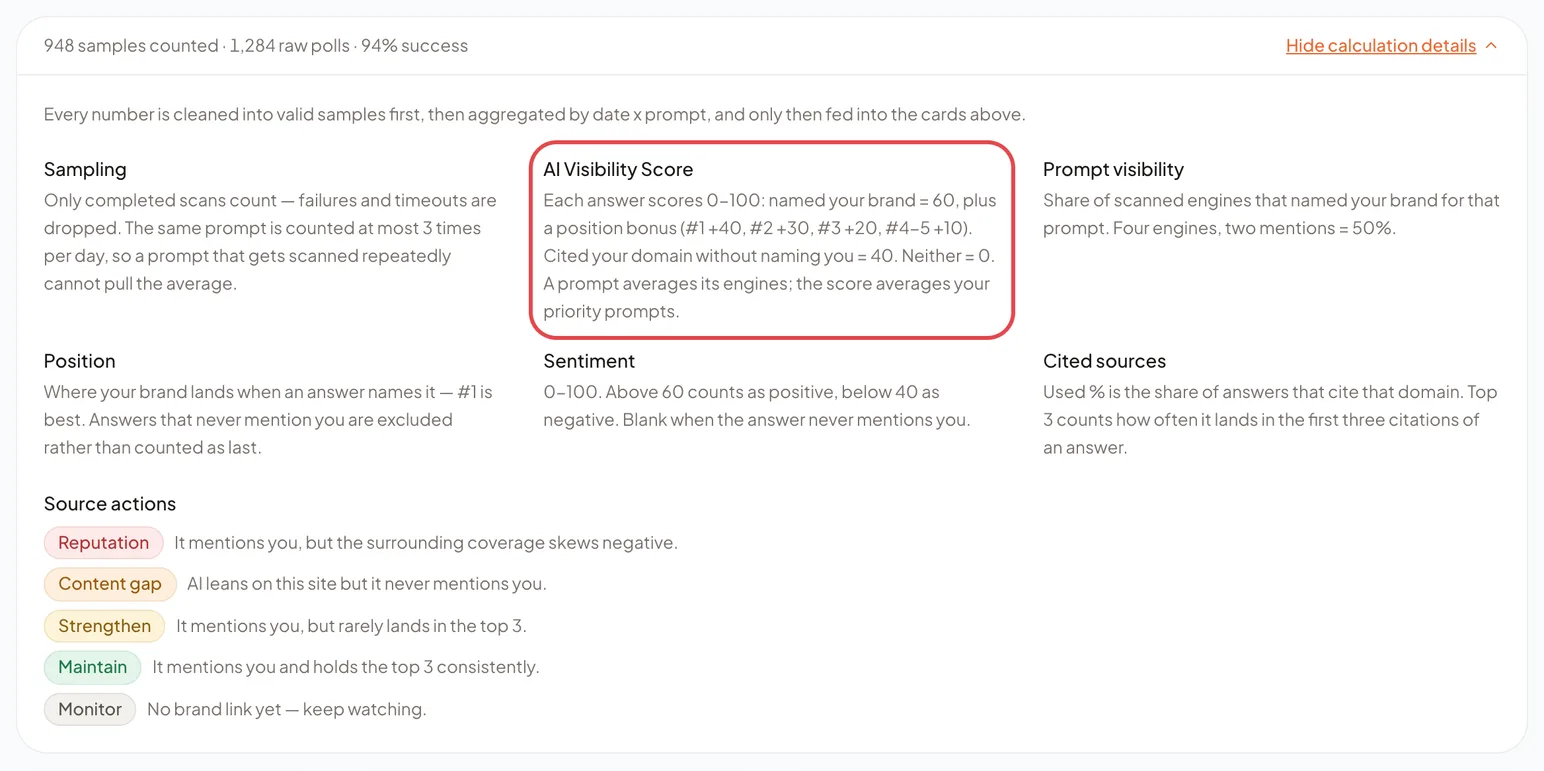
The same discipline applies to any score built on those runs: it should state its sampling rule and its formula, and keep a brand that is named apart from a domain that is only cited. In Bavior, open the calculation details: Sampling counts only completed scans and the same prompt at most 3 times per day, and the AI Visibility Score gives each answer 60 for naming your brand plus a position bonus (#1 +40, #2 +30, #3 +20, #4–5 +10), 40 for citing your domain without naming you, and 0 for neither. Read it as a summary of your fixed prompt set, not as proof that anything you changed caused a move.
Then price a citation before building a target around it. On Pew’s panel of about 900 US adults and 68,879 Google searches in March 2025, users clicked a traditional result in 8% of visits where an AI summary appeared against 15% where it did not, and a source inside the summary in about 1%.7 That is why the survey grades “citation scores predict clicks, conversions, or revenue” at very low confidence.1 Count a citation as a brand impression with a source attached, report it that way in the metrics that hold up, and promise no traffic you cannot trace.
Tooling
AEO tools: monitoring versus execution
Two products are sold under one word. The first tells you where you stand, the second changes it. Most budgets buy the first and are reviewed on the second.
| Monitoring and tracking tools | Done-for-you agencies | Bavior | |
|---|---|---|---|
| Question it answers | Where am I cited? | Where am I cited, and we handle it | Where am I cited, and what is next |
| What you receive | Dashboards and alerts | A monthly plan and deliverables | A queue of drafts to approve |
| What changes after | Nothing, unless someone acts | Whatever the scope covers | The pages and threads answers cite |
| Typical cost | Per-seat SaaS | $3,000–20,000/mo¹ | From $99/mo |
| Where it stops | At the report | At the scope you bought | Nothing publishes without approval |
The two are correctly measured on different things. A monitoring product is measured on coverage and fidelity: how many engines, how many runs per prompt, how faithfully it records which sources an answer cited. An execution product is measured on what changed afterwards. Buying the first and reviewing it as the second is the most common way an AEO programme spends a year producing charts and no movement. Neither can do the part with the best evidence for you: no tool makes a page relevant, indexed or well ranked.1 What tooling removes is the labour in between, and it concentrates on the cited sources that are live discussion threads.
The first week
How do you start with AEO this week?
1
Write the prompt set
Twenty questions a buyer would type, phrased about the category rather than about you: the shortlist question, the alternative question, and the pricing question. Your brand name belongs in at most two of them.
2
Run it and log every URL
Each prompt, on each engine you care about, five times across a week. Record the answer, every cited URL and whether your brand was named. Ten prompts by three engines by five runs is 150 rows, one afternoon, and the only baseline you get free.
3
Sort the URLs into three piles
Pages you own, pages that describe you, pages that never mention you. Fix retrievability and relevance on the first, correct the record where the second has your price wrong, decide deliberately about the third.
The unit in step one is a question a buyer would ask, grouped by theme, not a keyword. In Bavior, open Prompts: each row gives one question’s Visibility (the share of engines that named you), Position (where your brand lands inside an answer that names it, not a rank across the web) and Mentions (whether you and a competitor were named). Set All Models to a single engine to read each row one engine at a time, because engines disagree.
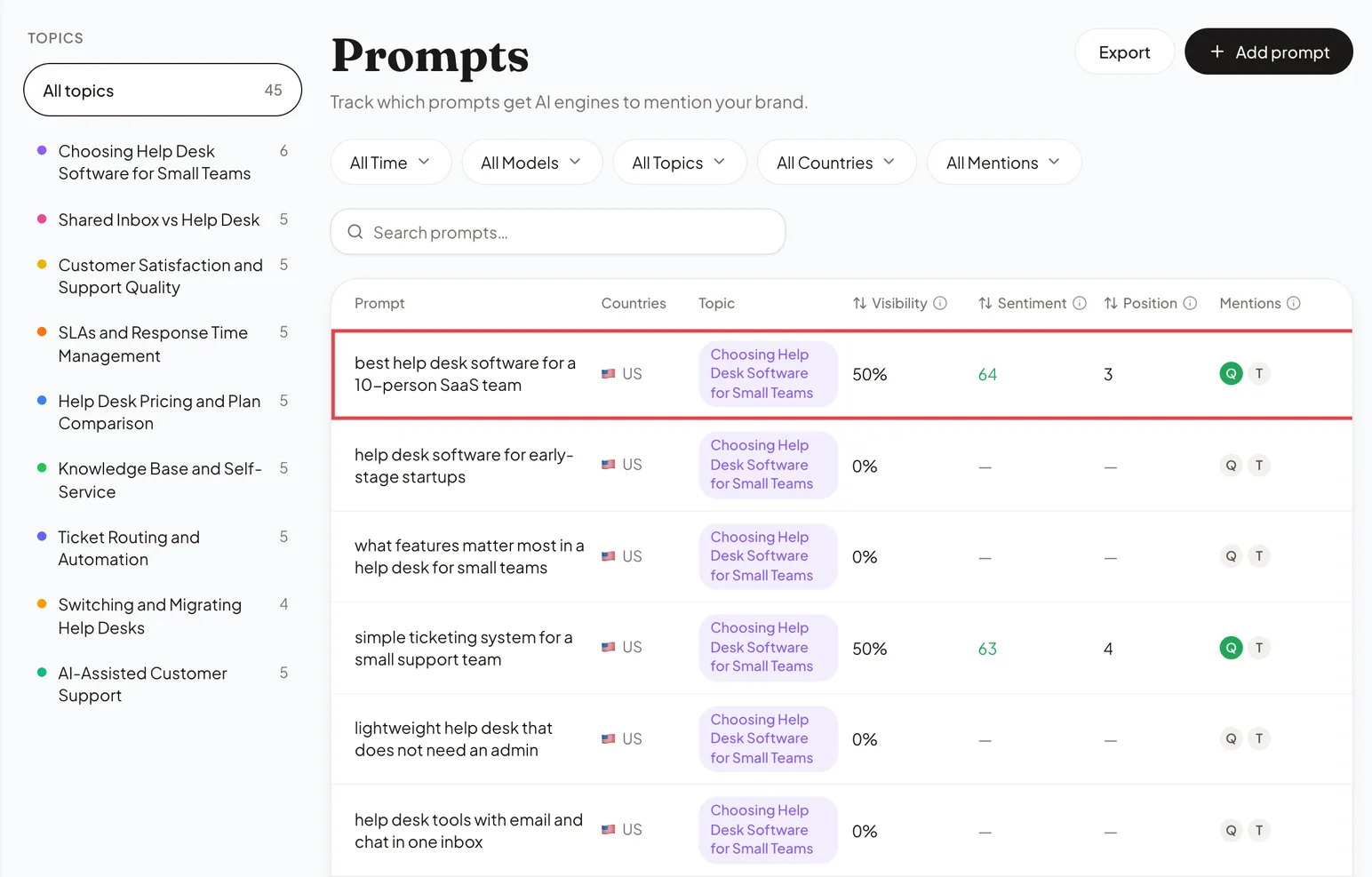
Then hold the prompt set still. The month-two temptation is to add prompts that are going well and drop the rest, which turns a measurement into a highlight reel. Keep the denominator visible, then read what actually gets cited.
The honest limit of this guide
Two of the eight sources are preprints, including the survey this page leans on hardest; its grades are one author’s judgment across 45 studies, not a meta-analysis. The feature table is descriptive and its influence score is a proxy its own authors decline to call causal. Engine behaviour also moves fast, which is why every figure carries the date it was checked.
Where a product fits, and where it does not
Everything above is doable by hand, and the first pass should be. What does not survive a real quarter is the repetition: a fixed prompt set, five engines, several runs a week, every cited URL logged so that citation share and share of voice are a series instead of a screenshot. That is the part Bavior runs on a schedule. Where a cited source is a live discussion thread, it drafts a reply in your voice on an account you control, and nothing goes out until you approve it; publish from Bavior’s aged accounts or from your own account manually, and both routes pass the same approval. It cannot place you on a roundup, buy an inclusion, or promise that an engine will cite you. What it does is keep the measurement continuous. See how the loop runs. Paid plans are from $99/mo.
Sources, all checked 12 Sep 2026
- Olivier Martinez, “Optimizing Visibility in Generative Engines: A Critical Survey of GEO (2023–2026)”, 15 Jul 2026, arXiv:2607.14035 (survey preprint); 45 studies; Table 5, evidence grades: arxiv.org/abs/2607.14035
- Puerto et al., “C-SEO Bench: Does Conversational SEO Work?”, NeurIPS 2025 Datasets & Benchmarks Track, 6 Jun 2025, arXiv:2506.11097; ten methods, more than 1.9k queries and 16k documents: arxiv.org/abs/2506.11097
- Zhang et al., “From Citation Selection to Citation Absorption”, 28 Apr 2026, arXiv:2604.25707 (descriptive preprint); 602 prompts, 21,143 search-layer citations, 18,151 fetched pages; evidence-genre table: arxiv.org/abs/2604.25707
- Grossman et al., “How Generative AI Disrupts Search”, SIGIR 2026, 30 Apr 2026, arXiv:2604.27790; 11,500-query benchmark; AI Overviews on 51.5% of representative queries; under 0.2 average Jaccard: arxiv.org/abs/2604.27790
- Google Search Central, “AI features and your website”, 10 Dec 2025 (query fan-out; the snippet-eligible entry condition; first-party): developers.google.com/search/docs/appearance/ai-features
- Google Search Central, “Optimizing your website for generative AI features on Google Search”, 10 Jul 2026 (core Search ranking systems; no new files or markup; first-party): developers.google.com/search/docs/fundamentals/ai-optimization-guide
- Chapekis and Lieb, Pew Research Center, “Google users are less likely to click on links when an AI summary appears”, 22 Jul 2025; about 900 US adults, 68,879 searches, March 2025: pewresearch.org
- Kirsten et al., “Characterizing Web Search in The Age of Generative AI”, Findings of ACL 2026; Google organic search against five generative systems; outputs “can vary across time and executions”: aclanthology.org/2026.findings-acl.526
FAQ
Frequently asked questions.
What is the difference between AEO and GEO?
Emphasis, not method. Answer engine optimization usually points at answer boxes and AI Overviews; generative engine optimization usually points at assistants such as ChatGPT and Perplexity. The pipeline underneath is the same, and the 2026 critical survey treats the terms as names for overlapping work. Pick one and stay consistent internally.
Does AEO replace SEO?
No. Google states that its generative AI features are rooted in its core Search ranking and quality systems, and that a page must be indexed and snippet-eligible to appear in them. AEO adds an editing and measurement layer to search work. There is no separate index to submit to.
Do AEO tactics like adding an FAQ block actually work?
The evidence is thinner than the advice. In a dataset of 21,143 AI citations, question-and-answer formatting is the one page feature associated with slightly lower influence, and a NeurIPS benchmark found only three of 54 rewriting cases produced statistically significant gains. Question-shaped headings above real answers are fine; expect no citation premium from the format.
How do you measure AEO?
As a share with a denominator, sampled repeatedly. Citation share is how often a URL you own is cited across a fixed prompt set; mention share counts your brand whether or not it is linked; share of voice compares you with every brand named in the same answers. Report per engine, because engines disagree.
How long does AEO take to show results?
Long enough that a first monthly report is mostly noise. Answers vary between runs and between engines, so any change needs repeated sampling across several weeks before it separates from variance. Treat the first month as baseline building rather than as a result, and hold the prompt set fixed while you do it.
Bavior Editorial
The team that researches and maintains Bavior’s writing on Reddit marketing and AI search visibility. Every figure here is attributed to a named source with the date it was checked, and none of our links are affiliate links.
Found a number that looks wrong? Tell us and we will re-check it: support@bavior.com